
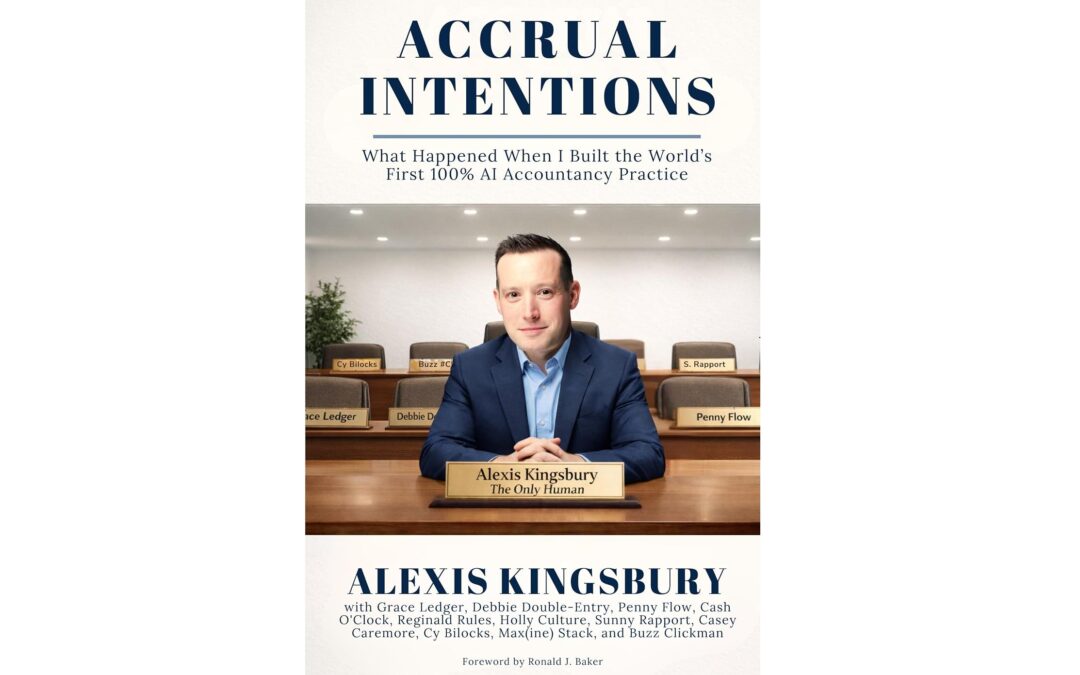
I read this book not long after it came out and am surprised there has been barely a mention of it within the Australian accounting profession. I’ve been a bit slow to write this but consider it an absolute must read for accounting firm leaders.
The full title is Accrual Intentions – What happened When I built the World’s First 100% AI Accountancy Practice.
Here is a quote from the website associated with the book https://accrualintentions.com
Why build an AI accountancy firm?
Accountancy is one of the world’s oldest professions — and one of the slowest to embrace new technology. [ I disagree with that statement!] While AI is transforming industries at pace, many firms were still running on spreadsheets, sticky notes, and goodwill.
So Alexis Kingsbury decided to make a point. In September 2025, he built an accountancy practice staffed entirely by AI — not “AI-assisted”, not “partly automated”, but eleven artificial colleagues with job titles, responsibilities, headshots, and personalities.
Behind the parody, each AI colleague runs on best-practice SOPs, workflows, and automations used by modern accountancy firms today — based on the Accountancy Practice Playbooks he developed with over 100 accountancy leaders.
The result? A website that confused the internet, a LinkedIn following that didn’t quite know what to make of it, and — eventually — a book.
I should point out that Kingsbury is not an accountant and he built a demonstration accounting firm not a “real” one. Read this book however and it will feel very real.
Kingsbury is a self described serial entrepreneur. He runs Ukoru, an online SaaS platform for making managing teams easy – Ukoru — Give your people and AI the foundations they need. He runs Bridging Insight, a consulting firm specialising in improving ways of working. Plus he has two software products – Spidergap (a 360 degree feedback tool) – Top Rated 360 Degree Feedback Software | Spidergap and AirManual (a process documentation platform) – AirManual | AirManual. And at the time he set out to build his accounting firm he was writing The Accountancy Playbooks – covering 30 areas of best practice in firms – The Accountancy Playbooks — How to grow your firm with less stress
When Kingsbury started building his accounting firm he said he hoped it would fail! He was going to use his work as the basis for a presentation at Accountex in London and thought he would be able to say “here is where AI failed and here’s why your jobs are safe”. It didn’t turn out that way.
The central message of the book is that AI is already capable of doing far more of an accounting firm’s work than many practitioners realise. However, successfully using AI requires rethinking how firms are structured, managed and controlled—not simply introducing new technology.
Kingsbury says he built the foundations of his new firm in just two mornings. He created 11 AI employees, each with their own skills and personality and very clear roles. You can see these 11 “employees” described here: https://accrualintentions.com/#team.
He started with the Managing Partner, Grace Ledger, and built out from there. He achieved a lot but it largely lay dormant until February 2026 when he used Claude Code (Opus 4.6) to refine his multi agent team. As part of this he asked each team member to keep a daily log to track the AI team’s performance – what went well, what went wrong, what rules they’d commit to going forward. He also created another log that would track his performance as the only human.
In short, the team became very capable and could deliver the work to a high standard as verified by a Chartered Accountant who allowed one of his businesses to be used as a test client.
The final chapter of the book is titled “Epilogue: What I Learned by Accident”. You really need to read the whole book to appreciate the comments he makes but I believe they are comments every accounting firm leader should read and act on.
Here are a few key points he makes:
What accrual Intentions proved to me, really proved, is that this shift in how we make things is now inevitable. Not “coming soon.” Not “on the horizon.” Happening. Right now. In ways that most people haven’t fully processed yet.
Because here’s what’s about to happen to every business, whether they’re ready or not.
Everyone is about to become a manager.
Not in the corporate sense. Not corner offices and performance reviews. In the practical sense: the ability to describe an outcome clearly, set boundaries around what’s acceptable, build in checks and reviews, and then let something else do the execution.
..the single most useful thing a leader can do right now is make sure their business is clearly documented. Values. Processes. Brand Guidelines. Decision making frameworks. Quality standards. The things that tell everyone (human and AI) what “good” looks like.
Because your employees are about to become ten times more productive. Maybe more. And if they’re working in the wrong direction, at ten times the speed, with ten times the output, that’s not an efficiency gain. That’s a ten times faster disaster.
Document your business as if you were handing it to a brilliant stranger. Because that’s what AI is.
I hope beyond hope that AI doesn’t replace the human jobs we enjoy. I think the answer isn’t fewer people: it’s higher standards. Raise the bar for what you can deliver to your clients and your teams. I believe leaders who reduce their headcount in the wake of AI will find they regret it later. And I believe AI team members collaborating with humans is the future. I don’t think I want a future where that’s not the case.
I’ve written a companion article to this review which you can find here: The AI enabled accounting firm. I hope it might prompt some further thinking and action from you. Please don’t ignore this!